


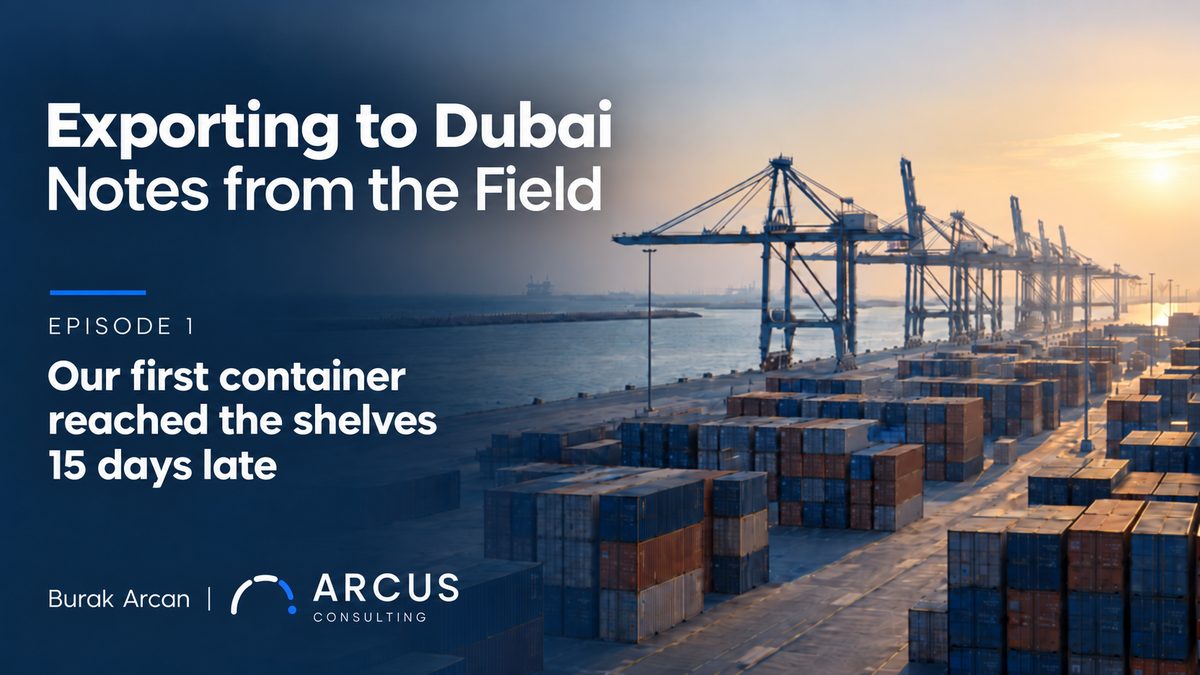
It was the first few months of Mahalle, the Turkish food business we set up in Dubai. Our first container was on its way from Türkiye, full of products we had picked one by one from women's cooperatives and producers who still make things the traditional way. Honestly, we couldn't wait to fill the shelves.
The container arrived at the port. The products made it to the shelves two weeks later.
Food imports in Dubai don't stop at customs
In Türkiye, when you think about importing, you think about customs. Paperwork in order, duty paid, the goods are released. With food in Dubai, that is only half of it.
The other half is the municipality. Every product, and every variant of the same product, has to be registered in Dubai Municipality's system and approved, and that has to happen before the goods ship. When the container lands, a municipality inspector comes and checks the products on site. So the container has to get through customs and the municipality.
One number says a lot about how routine these checks are. Dubai Municipality says it inspected 461,875 food containers in 2024 alone, covering close to two million products.
What happened to us
We knew this and had prepared for it. Even so, our products were held at the first inspection. We had missed one small detail on the label.
Prepackaged food labels in the UAE follow a national standard called UAE.S 9. Arabic is mandatory. Ingredients, allergens, country of origin, storage conditions, production and expiry dates all have to be written a certain way. If one of them is missing, or what is on the pack doesn't match what you registered with the municipality, the product doesn't get through.
We relabelled everything. We paid for the extra labour and lost a fair bit of time. The products reached the shelves 15 days late.
Two weeks of empty shelves in a store that has just opened is not something anyone wants. Lost sales aside, customers remember what they saw the first time they walked in. And with food there is shelf life to think about. While the product sits at the port, the expiry date keeps getting closer.
What I'd do today
We spotted that detail at the port, during the inspection. We could have caught it in Türkiye before the packaging ever went to print.
If I were doing it again, I'd have every label checked against the UAE standard before production, one product at a time. I'd also make sure what we registered with the municipality matched what was printed on the pack, word for word.
And I'd assume the first shipment would get a closer look and plan the timeline around that. The system pays more attention to new products and new importers. After a few clean shipments, things did speed up for us.
A few things to check before your first shipment
- Every variant of every product is its own registration. Five flavours means five registrations.
- Get someone who knows the UAE labelling standard to check the label design before it goes to print. Don't forget the Arabic.
- Put your registration details and your printed label side by side. Weight, ingredients, dates, all of it should match.
- When you set a launch date, leave room for the first inspection and a possible fix.
- If your products have a short shelf life, work out what a few days at the port would cost you.
Next in the series
Next time I'll write about another shipment. That one got held because the shelf life printed on the product was longer than the UAE allows.
If you're planning your first shipment to the Gulf, we can map out the compliance side for your products together. Take a look at our trade advisory.
About the author: Burak Arcan is the founder of Arcus Consulting, a Dubai business consulting firm working with manufacturers entering the UAE and the Gulf. Before Arcus, he set up Mahalle, a Turkish food business in Dubai, grew it and sold it.